A note on the convention used for presenting notations in this website.
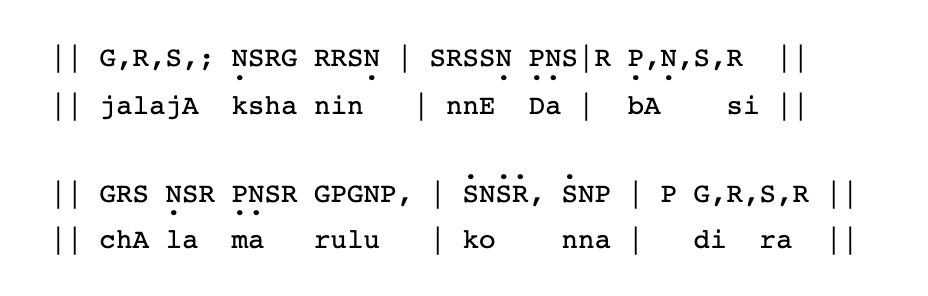
Traditionally, music notations follow this practice: a note by itself is ‘madhya sthaayi’ (mid octave); a note with a ‘dot’ on top is ‘tara sthaayi’ (higher octave) and a note with a dot below is ‘mandra sthaayi’ (lower octave).
Notation for ‘Jalajaksha’ varnam in Hamsadwani will typically go like this:
To make typing of such notations easier in a typical computer keyboard using English alphabet, the above convention has been mapped into the following:
- s r g m … (lower case) represents madhya sthaayi (mid octave)
- SRGM… (upper case) denotes taara sthaayi (higher octive)
- SRGM… (upper case, bold) denotes mandra sthaayi (lower octave)
Using this modified convention, the notation for Jalajaksha varnam in Hamsadwani looks like this:
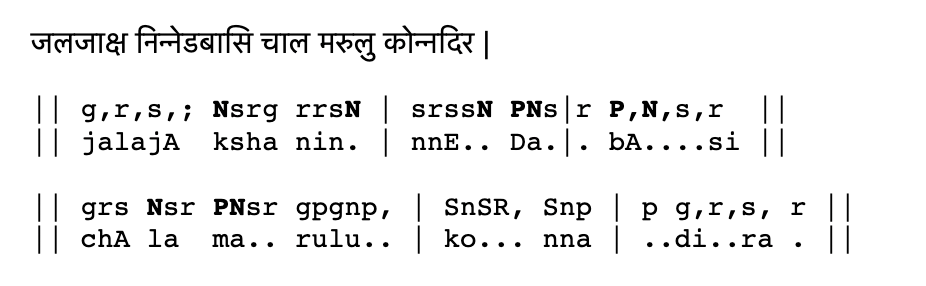
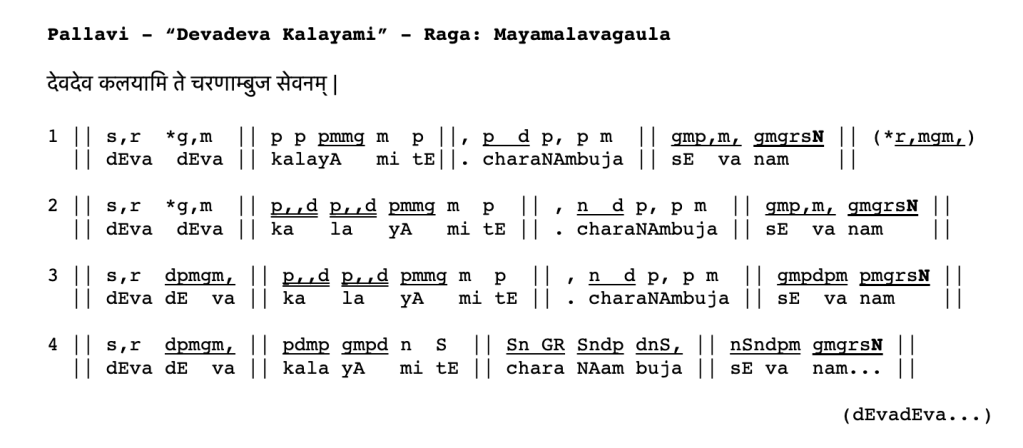
The rest of the conventions remain same as traditional notations – ie., comma represents one extra note, semicolon denotes two extra notes, etc. Further, a single underline is double the normal speed and double under line is four times the normal speed of rendering.
A sample notation is given below, written in the modified notation plan:
I have used this convention in all my lessons that I share with my students and haven’t received any major adverse feedback so far. So, it seems to be working fine!
Sahityam (Lyrics)
Writing lyrics in English and also denoting the correct pronunciation is a very difficult task. There are some conventions followed (eg., Transliteration as per Harvard-Kyoto Convention) – however, I found it to be somewhat cumbersome for both the learner and the Guru!
In addition, we have the reality that Karnatic music compositions fall into multiple languages (eg., Sanskrit, Telugu, Tamil, Kannada and Malayalam). Each langage has its own pronunciation specifics; and without a basic knowledge of each of the languages, it may well be impossible to render the lyrics correctly.
So, we follow a simplified convention here which gives a fair idea of the pronunciation – but is incomplete without an Indian language script. As a via-media, I have used Devanagari script to denote the lyrics in most of the texts.
The English text follows approximately the popular convention of “d” for द, D for ड, t for त, T for ट, n for न, N for ण etc. A capital letter indicates a deergham (ie. dA means दा; kAruNya is कारुण्य) etc.
All said and done, there is no substitute to learning the correct pronunciation by learning the basic elements of the language concerend and listening to artists who render the songs with correct pronunciations.
— Venkat
 Venkat Ayalur